
How to Get Found on Google and AI Search: SEO and GEO Tips for Small Business Owners

In today's search, and especially on AI search, the more unique you are, the more human you are, and the more on-brand, clear and consistent you are, the better you'll perform.
That makes this a really exciting time for small businesses looking to expand their visibility and get found by more of the right fit clients and customers.
In this post, inspired by the latest episode of The Favourite Self Podcast with our SEO and AI optimization strategist and copywriter at Web of Words, we’re diving into all of it.
If the word "SEO" makes you want to close your laptop, this one is for you. Here's the TLDR version…
Key takeaways
AI optimization is an expansion of SEO, not a replacement. The ways we can optimize your web presence for search have simply expanded to include GEO, or generative engine optimization.
Being human is a ranking advantage. The more unique, clear and consistent your brand is, the better search engines and AI tools can understand you and connect you with the right people.
How other people talk about your business matters more than ever. Reviews and testimonials are human feedback that AI search engines pay attention to.
Don't copy and paste from AI. Use it to bounce ideas around, but AI-generated content won't perform as well on search as human-written content.
Stop waiting until you feel ready. Confidence comes from engaging in the process, not before it.
Start with three things: make sure your website reflects who you are today, publish a blog, and get your testimonials onto your site.
Stepping into your ultra visible era
At Web of Words, we help business owners step into what we call their ultra visible era. It goes beyond rankings and website traffic.
Stepping into the spotlight can feel… scary. With most of the business owners we work with, there's one side of them that really wants to be found by amazing clients and wants to drive their business forward. And then there's the other part of them that's secretly a little bit scared to put themselves out there, because they don't know where that's going to land them or what that's going to look like.
Investing in SEO and AI optimization is one way to lean into being seen.
We've seen people totally come out of their shells when they embrace this next level of their business and change how they see themselves. What we love most is the confidence it gives business owners when they see more people coming in through their lead forms, or the most amazing clients they could imagine all of a sudden seeking them out.
Business owners wear so many hats. Being able to lean on a team you trust to check those boxes for you is such a relief. It takes a village to be seen, and having people mirror back your superpowers helps you see your own gifts.
Who leads our SEO and AI work: Jen, our SEO strategist, AI optimization expert and copywriter, started on the creative storytelling side of marketing before falling in love with search. The landscape has changed a lot in the last couple of years, especially with AI search, and we've had fun keeping up with those changes and learning to roll with the punches.
Why being more human helps you rank on search
At Web of Words, we blend getting to know the human behind the business (their story, their unique gifts, what lights them up and makes them different) with the strategy to help the right people find them. We bring that into their messaging, their design and their website, in a brand that feels like a true expression of who they are.
Here's what a lot of people don't actually know about being found on search:
In today's search, and especially on AI search, the more unique you are, the more human you are, the more on-brand and clear and consistent you are, the better you'll perform on search engines.
You've probably seen those websites from a couple of years ago with keywords thrown everywhere. Technically, they're supposed to perform great on search. But when you land there, they come across as weird and insincere and maybe not genuine.
Sure, you might get people to that website by focusing only on the search engine aspect. But are you going to get them to contact you? Are you going to get them interested in who you are and how you can help them? Without the creative piece, you're doing a huge disservice to your search presence.
That's the key: you need the strategy in place so people land on your site, and then the human connection so they actually convert. If it sounds like a robot wrote it, that's the quickest way to turn them off.
How we match what you want to be known for with what your clients search for
What if the language you use to describe your work isn't the same language your clients use when they search for it? Our process starts with two steps.
Get to know you deeply. If we don't understand you and your business, how can we bring the right people there? That's always the best place to start.
Switch seats. We put ourselves in the chair of your ideal client or dream client, and we take time to think about and research what they're searching for, whether they're going to Google and searching specific terms or going onto AI search or ChatGPT.
This is often one of the biggest challenges for clients who are leaders in their space. When your work comes naturally to you, a gap can open between how you talk about it and how your audience does. That's why we always say we need to continuously find ways to be our own client.
It's the best when our team gets so far inside the head of a client's audience that we sell ourselves on their products and services. Take my money too!
A few places we look for the words your clients actually use:
Client testimonials and reviews, including how they talk about other businesses.
The books they read, and how they talk about those books.
Video testimonials, which show how clients actually talk in conversation.
Tools like The Brand Mirror, which we just launched to help you understand your authentic design and soul's purpose in a whole other way.
What SEO does for your business, in plain language
For a lot of business owners, just hearing the word SEO is overwhelming. The truth is that SEO feels intimidating, but at its core, it's really not.
The most important thing is that you understand who you are, what your business is doing, what you have to offer, and what makes you unique. Because if you can't convey those things, how can you expect search engines (let alone your ideal client) to understand them?
That really is the first step. If you have clear, consistent and unique branding and you know who you are, search engines can use that information to link you up with the right people, especially with AI search.
Then there's the technical side. We very rarely meet a business owner who is invested in doing the technical fixes on their website. If you find it a little dry and boring, that's where we come in, because our team loves doing that stuff. The parts that feel a bit sticky, or that you don't want to learn? You actually don't have to. That's why we're here.
It's also worth asking whether DIY is where your time should go. What you think might be one hour quickly spirals into four, and suddenly you've spent your entire day tweaking your website when you could have been generating leads for your business.
What is GEO (generative engine optimization), and how does it connect to SEO?
A lot of people think SEO is separate from AI optimization. What AI optimization really is, is an expansion of SEO. The ways we can optimize your web presence for search have simply expanded.
That expansion now includes GEO, which a lot of people refer to as AIO. If you say AIO, people kind of get it. But it's actually called GEO, or generative engine optimization.
How GEO is different from traditional SEO
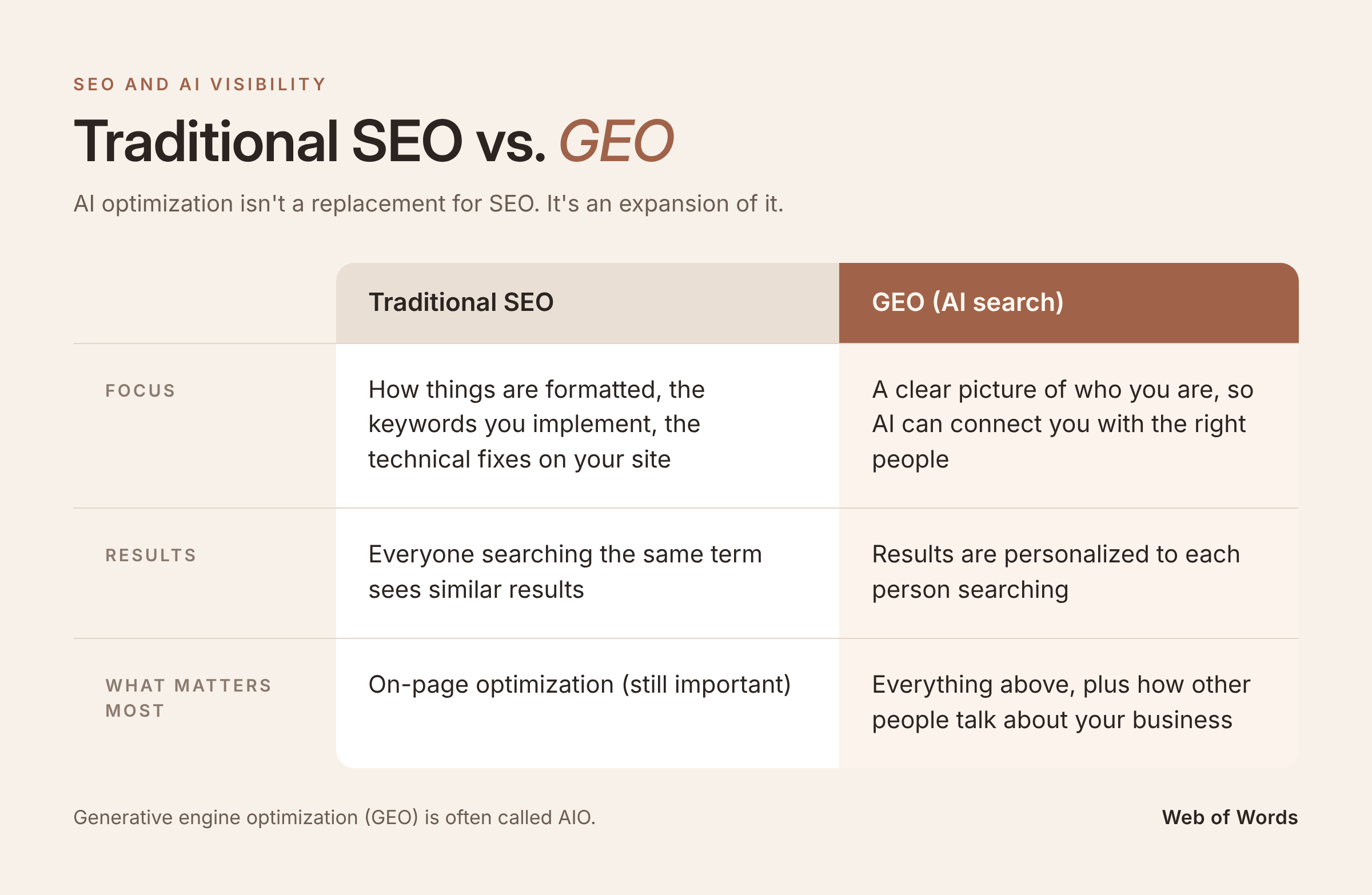
GEO is a lot more layered, a lot more nuanced and, maybe ironically, a lot more human-centred than optimizing for traditional search engines.
Why AI search results are personalized
Imagine you use ChatGPT every day for recommendations, for shopping, or when you're looking for service providers. It has come to know you in a certain way. It picks up on the things you like or don't like, your preferences, the things you connect with, and it uses that information to connect you with service providers.
If two people put the exact same search into ChatGPT, they won't get the same answer.
Say two people are both looking for a nutrition coach. AI search will understand them as different people and connect them to different providers. That's where the huge opportunity is.
There's more opportunity than ever for the right people to find you, and potentially the wrong people too, if you haven't done the work to get really intentional, honest and human about who you are.
Why reviews matter more than ever
Another thing that matters now more than ever is the way other people talk about your business. That's why reviews are so important, whether they're on Google, Facebook or industry-specific sites. Solicit them if you can, showcase them, and bring them to the forefront of your website.
Can you use ChatGPT or Claude to write your website copy?
We're starting to see this more and more in our industry: business owners publishing AI-generated content, or even sending their copywriter feedback that clearly came from AI after paying someone they trusted to write it.
Their heart's in the right place. They think they're doing the right thing, and our hearts really go out to business owners who get a little bit lost in that. But the truth is:
AI-generated content will not perform as well on search engines as human-written content will.
Search engines see that kind of content as not distinct enough, and as not adding anything to the millions of new pages that go up every day. Google will look at that web page or that new blog you put up, and it will essentially throw it into a black hole where it never sees the light of day. We see people sadly wasting a lot of time on this. They feel like they're saving time, but they're publishing pages that never get shown on Google to anybody.
Where AI can support the process
Use AI to bounce ideas off of and swap ideas.
Never copy and paste from AI writing tools straight onto your website. It's really only going to hurt you in the end.
Instead, use AI to repurpose your own words. Drop in a podcast transcript, a voice note or a call transcript, and ask it to turn it into a blog post, an email or whatever you need, while “keeping as much of the wording verbatim as possible”. Then take the time to go back in and edit as needed, so it truly sounds like you.
We've also tested asking ChatGPT to make content more search-engine friendly. It really doesn't do that great of a job. It's a different level when you work with a professional who has done the research on the keywords, knows which ones are best for your audience and best to help you rank, and knows exactly where to place them.
What is AI copy actually costing you?
We hear that content is cheap. But is it, if it's not getting you the results you need? Maybe it saved you time. But if you're using it strategically, you've spent the time to learn it and train it. And if you're just copying and pasting and it isn't serving you on the other end, these robots are all talking to each other. They know. The robots know.
How to get visible when you're uncomfortable promoting yourself
You love your work, but sharing it with the world feels uncomfy. Our number one tip:
Stop waiting until you feel ready. That moment when all of a sudden you're going to have the confidence is not coming. It happens when you start engaging in the process.
There's an energy to taking the step. You pay that invoice, you send off the info, and you tell yourself, I'm doing this. That's the first step.
A website project isn't passive. There's a lot of back and forth, and our clients are along for the ride. It's through that process that they start to get their confidence and realize they're ready to call in amazing clients. All of a sudden those people are finding them, and they realize: I deserve this. I worked for this. It's really amazing to witness.
I used to be the person who had to have it perfect before I even shared it, but then I'd end up changing it anyway. You don't need to have it all figured out. You take one step at a time, the right step, and you surround yourself with the right team to fill the gaps you don't need to fill.
Letting go so you can grow
Then there’s the letting-go part, which is key to expansion. There comes a point in your business growth where you realize: I don't have to hold on to all of this. I can let other people in.
Entrepreneurs and business owners are so passionate about what they do. They don't want to be fixing redirects in their back end or changing meta descriptions. That's where the expertise of an SEO strategist comes in. So let people help you, and let people in.
When you know that's taken care of, you see it in the results: new leads, and not just new leads, but aligned dream clients who are so excited to work with you and then refer other dream clients to you. It becomes a magnetic, authentic presence.
You have a beautiful website you love. It's optimized for search. Amazing people are coming to you. Then, all of a sudden, you're booked, and you get to be really choosy about who you work with.
From there, you've climbed that mountain, and you get to move on to the next one, whatever that is for you and your business.
Why trust matters when you hire for SEO
Handing it off is a big deal, especially for SEO, where a lot of people have been burned before. Maybe they got one of those rogue emails in their Gmail and decided to respond, or went with someone they didn't know that well but who seemed trustworthy.
What's different about working with the Web of Words team is that we really take the time and energy to get to know people. That depth of care is what builds trust. We're not here just so you'll pay the invoice and we can kick your butt out the door. We truly care about you, and we want to see you be successful. Because seeing your dreams come to life is what fuels our own.
What happens when the faucet turns on
We've been in business for almost 12 years, and we've seen so many client dreams come to fruition: opening new locations, doubling their staff, opening second or third locations.
Some clients came to us saying they didn't think they'd use a website because they got all their clients through Instagram. Now they tell us they get so many dream clients through their website that they didn't realize it was a faucet that was turned off. Turning it on has freed up their time and streamlined their systems and processes.
The outcome is so much bigger than just, “I have a website now.” It fundamentally changes the way people see their business and the way they see themselves.
Your website is like your home. It's a place where you feel safe and comfortable sending people, because it truly reflects the real you, versus that feeling of cringing: "Here's my website, but I don't use it. It's not actually representative of who I am or how I work, like, at all."
3 things to check on your website first
If you're feeling that cringe about your website, or you just opened it after reading this, here's where we'd start.
1. Does your website still represent you?
Go back to the basics. Do you feel your website represents you, and is it consistent with what you have to offer? Are you still offering all the services on there? Is it speaking to the clients you're intending to speak to? Does it still reflect where you are in your business today?
If you don't know these things, how can search engines possibly understand and recommend you to the right people? It sounds basic, but it's so important to nail this down before you start building on all the other pieces.
2. When did you publish your last blog?
We're ride-or-die bloggers. We've seen blogging completely change business owners' web presence and their ability to call people in.
We really believe in the power of a blog when it's done well. That means not copying and pasting from ChatGPT, but sitting down yourself or hiring it out, and writing something that feels really meaningful and helpful to your audience.
3. Are your testimonials on your website?
Whether they're sitting in a Word doc on your Google Drive, you have to copy and paste them from your Google Business Profile, or they're buried in your emails, get your testimonials onto your website.
One thing AI search engines care about more now than ever before is the way other people talk about your business, because they know it's human feedback about what it's like to work with you.
A note for anyone who loves small business: this is your reminder to go leave a review. It literally takes three minutes to share your experience, and it can make a world of difference for a business owner you loved working with.
How do you know it's time to bring in SEO and AI visibility support?
It's not about feeling ready or not feeling afraid. It's totally normal to feel a bit of trepidation, and also to be really curious.
If you're curious about what it could be like to call in not just more people, but the right-fit people, and it's in the back of your mind when you lay your head down at night, just go for it.
The right moment is whenever you decide that it is. If you have that foundation of knowing who you are and you're ready to start being choosy with the clients coming to you, let's do this.
And there's a reason to move now. We're seeing businesses that implement AI optimization take off, because not every business is doing it yet. A lot of SEO tactics take time to build, but with AI optimization, you can generally see results quite quickly. So jump on it now, and see where you can be by the end of the year.
Your next step: book an SEO and AIO audit
Head over to webofwords.ca and book your SEO AIO audit. It's a great first step, and our SEO lead, Jen, will have her hands and eyes in the back end of your business.
We're in the final stretch of the year, planting the seeds for 2027. Now is the time to get these pieces tied up with a pretty bow, so that when you're casting big visions for next year, you're hitting the ground running. And there's still lots of time to make this quarter your best yet. We've got you.
Frequently asked questions about SEO and AI optimization
Is AI optimization (GEO) different from SEO?
AI optimization is an expansion of SEO, not a separate thing. The ways we can optimize your web presence for search have expanded to include GEO, or generative engine optimization, which many people call AIO. Traditional SEO still matters.
What helps a small business show up in AI search like ChatGPT?
A clear, consistent and unique brand, so AI tools understand who you are and who you serve, plus reviews and testimonials that show how other people talk about your business.
Will AI-generated website copy hurt my SEO?
Our rule is to never copy and paste from AI writing tools onto your website. Content that isn't distinct and doesn't add anything new won't perform as well as human-written content.
How long does AI optimization take to work?
Many SEO tactics take time to build. In our experience, optimizing for AI can show results quite quickly.
Where should I start with my website's SEO?
Make sure your website reflects who you are and what you offer today, publish a meaningful blog, and get your testimonials onto your site.
Listen to the full episode
This post is adapted from our conversation on The Favourite Self Podcast. Listen to the full episode here.